Two solar lift systems in Dhanusha give vulnerable families water in the dry months, and the people who use them own and look after them.
For a farming family, water shapes decisions long before harvest: when to plant, what to grow, and whether a dry spell is a small setback or a serious loss. Dhanusha is rated “Very High” for drought risk and exposure, so these decisions sit at the heart of women’s livelihoods.
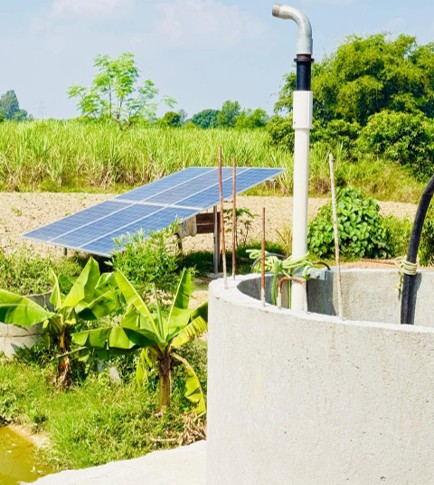
Through our RECET project, we installed two group-based solar lift irrigation systems. Each one serves six poor and vulnerable families.
Why use the sun
------------
A solar pump runs on sunlight instead of diesel, so there is no fuel to buy. It works best with a reliable water source, good equipment and regular maintenance.
Shared by six families, owned by the users
---------------------------------------
Each system irrigates about 3 kattha for each of its six households, around 18 kattha (about 0.6 hectare) per system. Together, the two systems serve 12 families.
Just as important is who owns them. A user committee manages each system. It collects NPR 20 per kattha for irrigation and keeps the money for repairs and maintenance. The system belongs to the people who use it, so they have every reason to look after it.
Water works best with know-how
---------------------------
A pump helps most when a woman knows when to irrigate, what to grow and how to save water. That is why all 100 women in RECET completed practical training and coaching on water management, soil-moisture conservation, crop diversification, drought-tolerant crops and composting.
Switching from diesel to sun does not mean endless water. Shared rules on who uses water and when, and regular checks on the water source, protect it for everyone.
At a glance
• 2 group-based solar lift irrigation systems
• 6 poor and vulnerable families per system, 12 in total
• About 3 kattha per household, around 18 kattha per system
• Owned and managed by user committees, with NPR 20 per kattha kept for repairs and maintenance
What comes next
---------------
Two systems are a first step, and they show that community-owned irrigation can work. The next steps are to grow the repair fund as the equipment ages, to keep repair services within reach, and to keep simple records of how the systems perform across seasons: area irrigated, crops grown, running costs and the time women spend on farm work.
If you invest in climate adaptation, this is a practical place to start. Community ownership, informed farmers and fair water rules together can make dry-season farming possible for more families. JWAS has identified more than 20 settlements across Mahottari, Siraha, Parsa and Rautahat where this approach can grow.
About RECET: Resilience for Women through Climate-smart Economic Transformation (RECET) worked with 100 marginalized women and their households in ten drought-prone settlements of Dhanusha, Nepal.